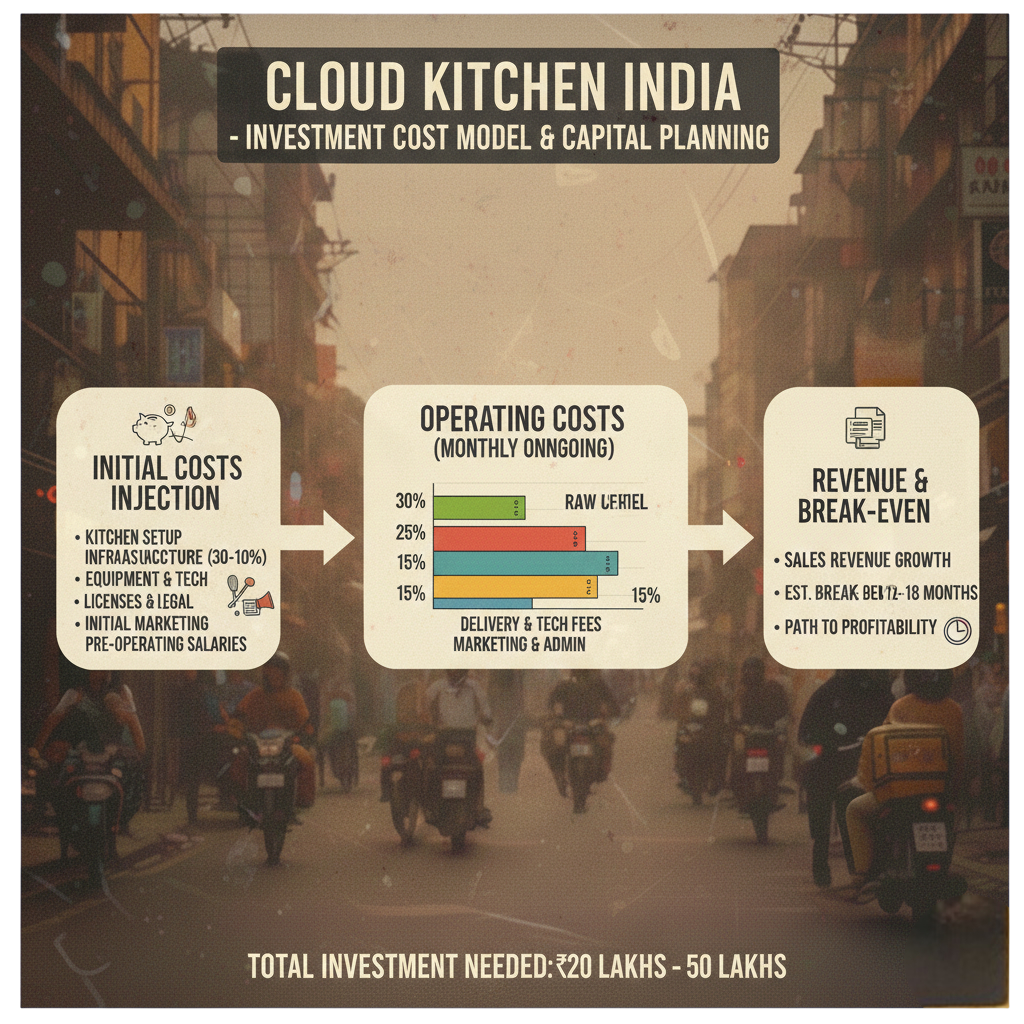
The cloud kitchen investment cost in India is one of the most misunderstood aspects of the delivery-first food business. While cloud kitchens are often marketed as low-investment opportunities, real capital requirements depend on business goals, city, cuisine complexity, and scale. This guide explains the true cloud kitchen investment cost in India, capital breakup, risk zones, and how founders and investors should evaluate returns realistically.
Start Here Before Estimating Cloud Kitchen Investment
This article is part of GrowKitchen’s investment, unit economics, and scalability series. Before evaluating capital requirements, understand how the cloud kitchen model functions in India: Cloud Kitchen as a Service and Cloud Kitchen Business in India.
All food businesses in India must comply with regulations issued by FSSAI, taxation rules under GST, and MSME registration norms.
Cloud Kitchen Investment Cost in India Explained
Cloud kitchen investment cost refers to the total capital required to launch, stabilise, and sustain a delivery-only food business until it reaches operational breakeven.
Unlike setup cost, investment cost includes buffer capital for working capital cycles, marketing, experimentation, and early-stage inefficiencies.
Key Components of Cloud Kitchen Investment
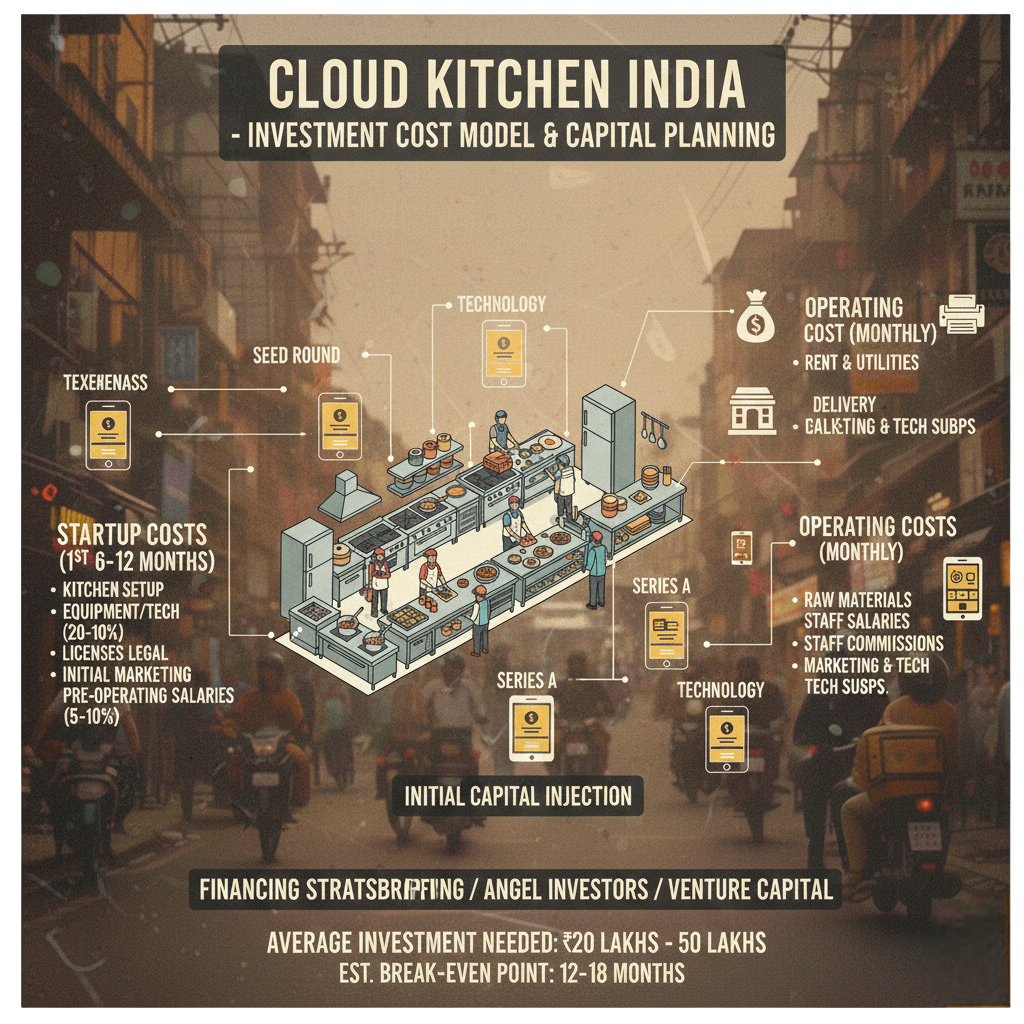
Cloud kitchen investment in India is broadly divided into three major components.
- Initial setup and infrastructure investment
- Operating capital and burn buffer
- Growth and visibility investment
Ignoring any one of these creates capital stress within the first 3–6 months.
Setup Cost vs Investment Cost
Many founders confuse setup cost with investment cost. Setup cost covers kitchen, equipment, and licenses. Investment cost includes survival capital.
A kitchen that launches with only setup capital often shuts down before achieving stability.
Working Capital Requirement
Working capital is the most critical part of cloud kitchen investment.
It covers staff salaries, raw material cycles, packaging, aggregator payouts, and marketing spends before revenue stabilises.
Marketing and Visibility Investment
Cloud kitchens rely heavily on digital visibility. Investment in photography, promotions, platform ads, and brand positioning is unavoidable in competitive cities.
Over-spending on discounts without repeat-order strategy is one of the fastest ways to burn capital.
How Investment Cost Varies by City
Investment cost differs significantly between metro and non-metro cities.
Metro cities require higher capital buffers due to rent, staff cost, and aggressive competition.
Investment in Managed vs Independent Cloud Kitchens
Managed cloud kitchens reduce setup complexity but increase long-term operational cost.
Independent kitchens require higher initial effort but offer better margin control over time.
ROI Expectations in Cloud Kitchen Investments
Cloud kitchen ROI depends on unit economics, not brand hype.
Investors should evaluate contribution margin, payback period, and scalability instead of topline GMV.
How to Control Investment Risk
Capital discipline matters more than capital size in cloud kitchens.
Strong SOPs and visibility systems reduce capital leakage: Cloud Kitchen SOP Checklist.
Investment Impact of Scaling
Scaling multiplies investment exposure. Each new kitchen requires setup capital, working capital, and operational bandwidth.
Sustainable expansion frameworks: How to Scale Cloud Kitchens.
Why Cloud Kitchen Investments Fail
Most cloud kitchen investments fail due to weak financial planning, not lack of demand.
Founders often underestimate burn rate, ignore contribution margins, and expand prematurely. A deeper breakdown: Why Cloud Kitchens Fail in India.
Final Thoughts: Cloud Kitchen Investment Cost in India
Cloud kitchens offer one of the most capital-efficient entry points into food businesses-but only when investment is structured intelligently.
Founders and investors who plan for stability, visibility, and systems consistently outperform under-capitalised launches.
FAQs: Cloud Kitchen Investment Cost in India
What is the minimum investment for a cloud kitchen?
It varies by model and city, but investment must cover setup and burn buffer.
Is cloud kitchen a good investment?
Yes, with disciplined unit economics and controlled scaling.
How long does it take to break even?
Typically 6–12 months with stable execution.
Do cloud kitchens scale faster than restaurants?
Yes, but only with strong SOPs and controls.
- Cloud Kitchen Business in India
- Cloud Kitchen Setup Cost in India
- Cloud Kitchen Business Cost in India
- Cloud Kitchen SOP Checklist