Swiggy vs Zomato for cloud kitchens is not a branding debate it’s an operations and profitability decision. Both platforms bring demand, but they behave very differently in terms of commission structure, order quality, visibility algorithms, customer behavior, and control. Many cloud kitchens fail not because they chose the wrong platform, but because they didn’t understand how each platform actually works. This guide breaks down Swiggy vs Zomato specifically for cloud kitchens: revenue impact, margins, order mix, marketing control, scalability, and which platform works better at different stages.
Start Here Before Choosing Between Swiggy and Zomato
This article is part of GrowKitchen’s aggregator economics and operations series. If you’re still understanding the cloud kitchen ecosystem, start with: Cloud kitchen as a service
Platform choice must align with your kitchen model. Asset-light, managed, and multi-brand kitchens perform differently on each platform: Asset-Light Cloud Kitchen Model in India.
Swiggy vs Zomato: Why This Decision Matters for Cloud Kitchens
For most cloud kitchens in India, Swiggy and Zomato together contribute 70–95% of total orders. That means these platforms are not marketing channels they are your primary sales engines.
Choosing how to operate on Swiggy vs Zomato impacts:
- Commission outflow
- Order volume vs order quality
- Discount dependency
- Customer repeat behavior
- Scalability across locations

Platform Overview: How Swiggy and Zomato Differ at a Core Level
While both are food delivery aggregators, their internal mechanics differ.
Swiggy at a Glance
- Higher order volume potential
- Strong last-mile logistics
- Algorithm favors fast prep and high acceptance
- More aggressive discount culture
Zomato at a Glance
- Stronger brand loyalty and repeat users
- Gold / membership-driven ordering
- Better control over discounting
- More stable order behavior
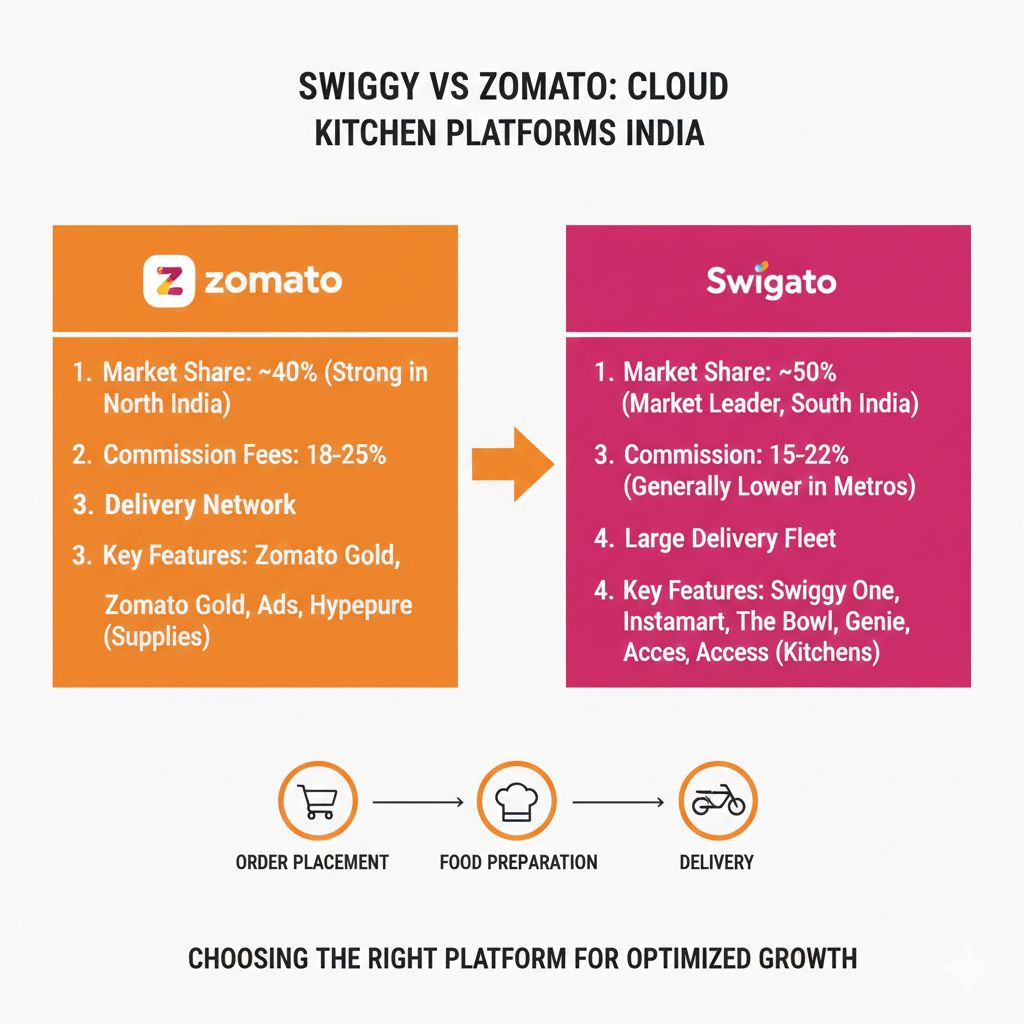
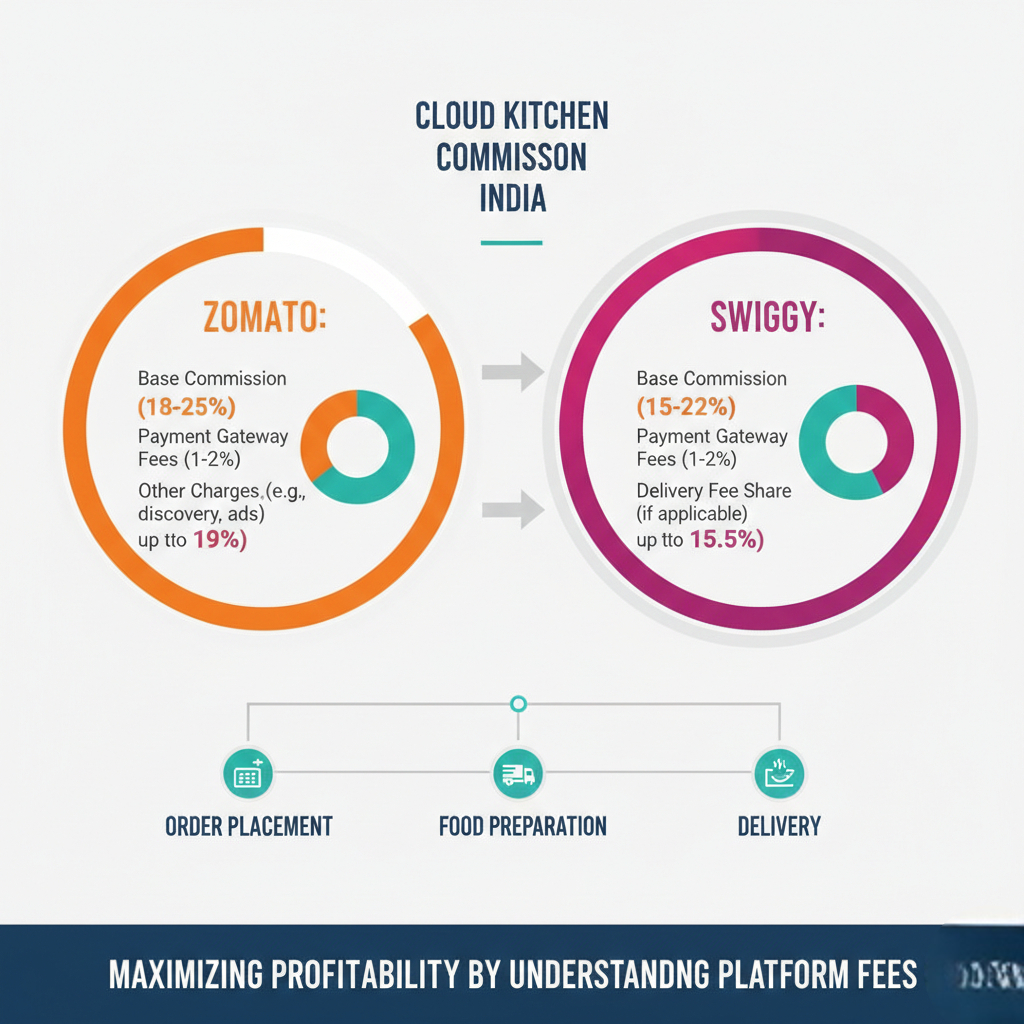
Commission Structure: Swiggy vs Zomato
Commission is the single biggest cost after food cost and labor.
- Swiggy: 22%–28% (can go higher with ads)
- Zomato: 18%–25% (generally more negotiable)
However, lower commission does not always mean higher profit. High-discount orders can quietly kill margins.
Learn how commission affects unit economics: Cloud Kitchen Unit Economics.
Order Volume vs Order Quality
A common mistake is chasing volume without understanding order quality.
Swiggy Order Behavior
- Higher impulse orders
- Price-sensitive customers
- Discount-driven spikes
- Lower average order value in many cuisines
Zomato Order Behavior
- Higher repeat frequency
- Gold members ordering regularly
- More stable AOV
- Better brand recall
Advertising & Visibility Control
Both platforms push paid visibility but with different consequences.
- Swiggy Ads: Immediate volume, fast burn, algorithm-dependent
- Zomato Ads: Slower growth, but more predictable ROI
Many kitchens mistake ads for growth instead of using them for stabilization.
Operational Pressure on Cloud Kitchens
Platform choice affects daily kitchen stress.
Swiggy Operational Impact
- Higher peak-time pressure
- Strict prep-time penalties
- More rider coordination
Zomato Operational Impact
- Smoother order flow
- Lower cancellation chaos
- More forgiving prep windows
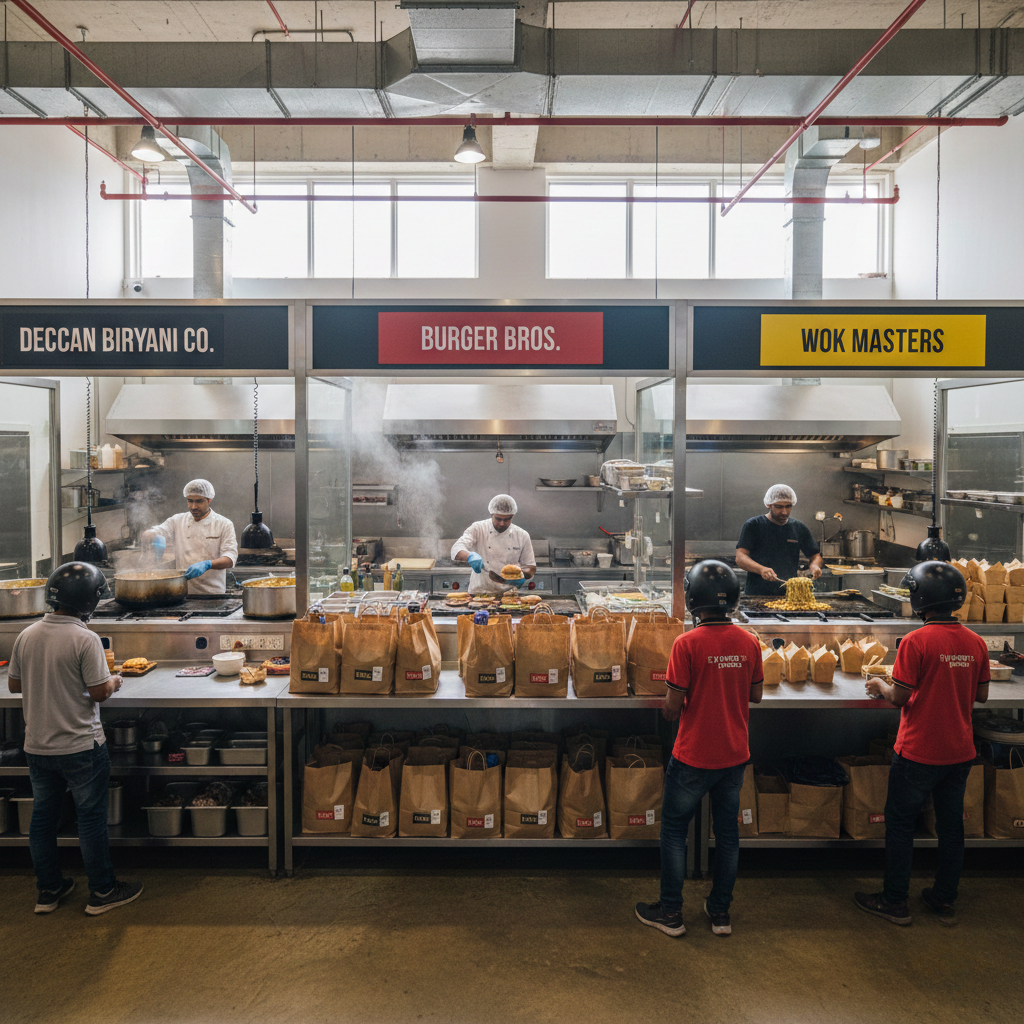
Swiggy vs Zomato for Multi-Brand Cloud Kitchens
Multi-brand kitchens behave differently on each platform.
- Swiggy rewards aggressive expansion and menu breadth
- Zomato rewards focused brands with consistent ratings
Managed kitchens and CKaaS models often split strategy: CKaaS Model in India.
Which Platform Is Better for Scaling?
Scaling is not about where you get more orders it’s about where you get more controllable profit.
- Early-stage kitchens: Swiggy helps discover demand
- Stabilized kitchens: Zomato helps build consistency
- Multi-city brands: Both are required with different playbooks
Scaling mistakes are covered here:
Why Cloud Kitchens Fail in India
See this – linkedIn
Final Verdict: Swiggy vs Zomato for Cloud Kitchens
Swiggy vs Zomato is not an either-or decision. Successful cloud kitchens understand how to extract value from both.
Use Swiggy for demand discovery and volume learning. Use Zomato for stability, repeat behavior, and brand retention.
Platforms don’t build profitable kitchens systems do.
FAQs: Swiggy vs Zomato for Cloud Kitchens
Which platform gives more orders?
Swiggy generally gives higher order volume, especially in dense clusters.
Which platform is more profitable?
Zomato often delivers better margin stability due to higher repeat behavior.
Should a cloud kitchen list on both?
Yes. Most profitable kitchens use both platforms strategically.
- Cloud Kitchen Business in India
- Cloud Kitchen Profit Margin
- Cloud Kitchen Unit Economics
- CKaaS Model in India