Cloud Kitchen Operation Consultant: Fix Execution, Ratings & Profit Without Guesswork
If your kitchen is getting orders but execution feels messy late dispatch, inconsistent taste, rising food cost, and staff depending on memory you don’t need more experiments. You need an operations system that runs daily, even when you’re not present. This guide explains what a cloud kitchen operation consultant does and the exact frameworks that stabilise delivery-first kitchens.
Why Most Cloud Kitchens Need Operations Consulting
Most cloud kitchens don’t fail because the food is bad. They fail because daily execution is uncontrolled. The kitchen runs on WhatsApp, memory, and “senior staff intuition” and that breaks the moment there’s peak, a staff change, or a new outlet launch. A cloud kitchen operation consultant builds a repeatable system so your outcomes don’t depend on who is present on a given day.
If you relate to any of these symptoms, you’re already paying the “operations tax”: frequent late orders, packing misses, inconsistent taste across shifts, sudden food cost spikes, stockouts during peak, or negative reviews around cold food and leakage.
If you’re building from scratch, start here: End-to-End Cloud Kitchen Setup.
What Is a Cloud Kitchen Operation Consultant?
A cloud kitchen operation consultant is responsible for building and fixing the systems that drive daily execution: station workflow, SOPs, staffing roles, prep planning, inventory controls, portion discipline, packing/dispatch checklists, quality checks, and KPI tracking. The consultant’s job is to remove randomness so the kitchen performs consistently even under stress.
This role is different from marketing, menu consulting, or a one-time audit. Operations consulting is about making sure the kitchen delivers the same taste, speed, and accuracy every day because that is what keeps ratings stable and repeat orders high.
What an Operations Consultant Fixes (End-to-End)
Good operations consulting touches every part of the kitchen cycle. Not by adding complexity, but by designing a simple and enforceable routine. Here’s what the scope usually covers in a delivery-first model.
Prep Planning
Daily prep sheets, par levels, and batch schedules so peak doesn’t feel like a surprise.
Station Workflow
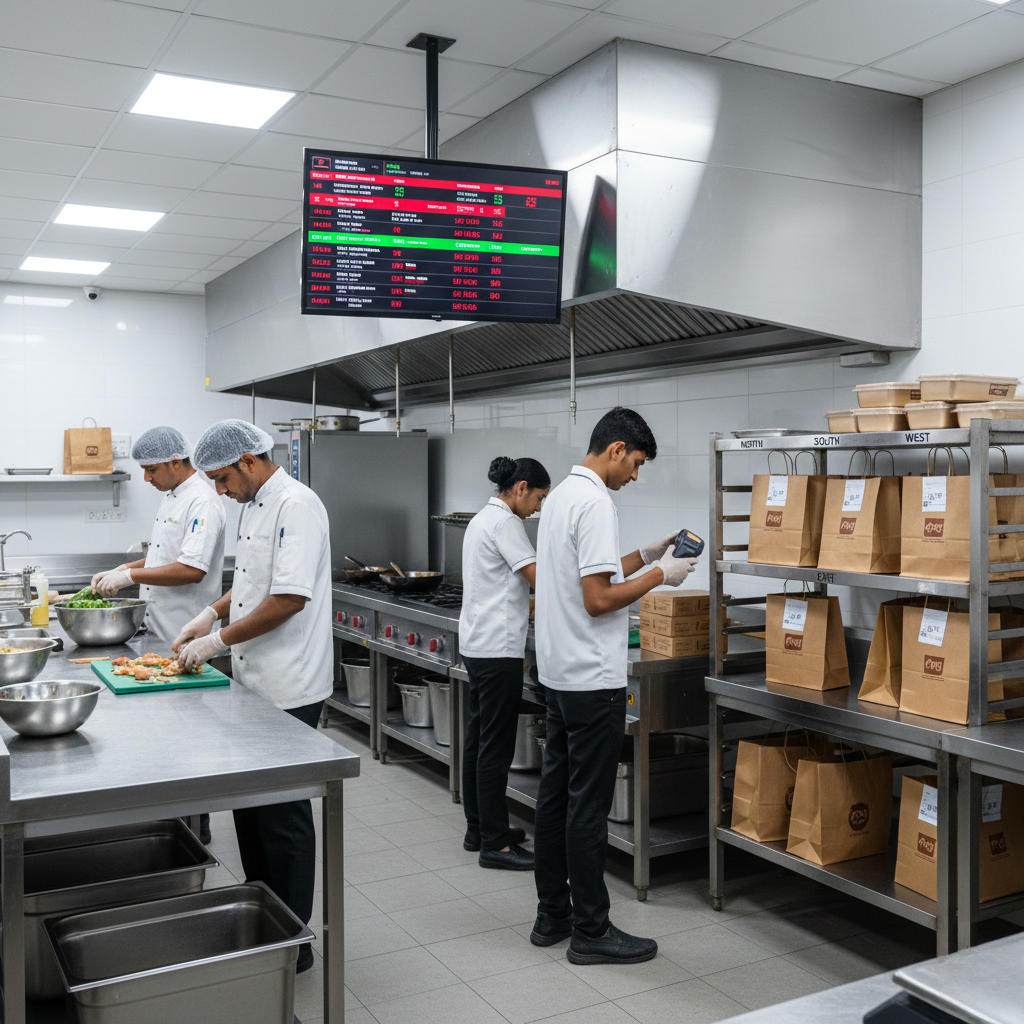
Clear movement: receiving → prep → cooking → assembly → packing → dispatch shelf.
Packing & Dispatch
SKU-wise packing rules, hot/cold separation, label discipline, and error-proof checklists.
Inventory & Portion Control
RM mapping, FIFO discipline, portion tools, wastage logs, and variance checks.
For operational frameworks and execution systems:
Cloud Kitchen Operations Management
See this -linkedIn.
The 7-Day Diagnosis Framework
Before fixing, a consultant diagnoses the real constraint. Many founders assume the issue is “low orders”, but the truth is often: your kitchen can’t handle peak cleanly, and the algorithm punishes you through cancellations, delays, and ratings.
Day 1-2: Data + ground reality
- Order journey mapping: order time → prep start → pack → rider pickup
- Peak hour bottleneck identification (which station breaks first?)
- Top complaint clustering: leakage, cold food, missing items, taste drift
- Menu complexity audit: too many variants, weak SOP clarity, confusing add-ons
Day 3-4: Process + station audit
- Tool mapping: standard ladles/scoops/timers to remove estimation
- Station zoning: does the kitchen have a clean flow or chaotic cross-movement?
- Packing table audit: are you missing a checklist + label rule?
- Dispatch shelf rules: is food dying while waiting for riders?
Day 5-7: Inventory + staffing reality
- Par levels and reorder triggers for top items
- Food cost drift causes: over-portioning, freebies, wastage, rework
- Role clarity: who owns prep, who owns packing, who owns handover?
- Training gaps: what “standard” means in grams and minutes, not opinions
SOPs That Actually Run Daily (Not PDF Decor)
Many kitchens have SOPs, but they don’t run them. A real operations SOP is not a document it’s a routine. It must be short, measurable, and tied to tools. The purpose of SOPs is to make outcomes predictable: prep quantity, portion size, packing accuracy, and dispatch speed.
Non-negotiable SOP categories
- Opening SOP: equipment checks, stock checks, station readiness checklist
- Prep SOP: batch sizes, labels, storage rules, shelf-life discipline
- Cooking SOP: timers, holding rules, reheat rules, taste checkpoints
- Packing SOP: SKU checklist, hot/cold separation, seals, cutlery, dips
- Dispatch SOP: shelf rules, rider handover, delay escalation
- Closing SOP: wastage log, stock count of critical items, cleaning checklist
If you want ready SOP formats: Cloud Kitchen SOPs.
Station Design: Prep → Assembly → Packing → Dispatch
A cloud kitchen wins by speed and accuracy, not by “chef creativity” during peak. That means stations must be designed like a production line simple movements, no cross-contamination, no searching for tools. A consultant structures stations so a new staff member can perform with minimum mistakes.
Station 1: Prep & portion
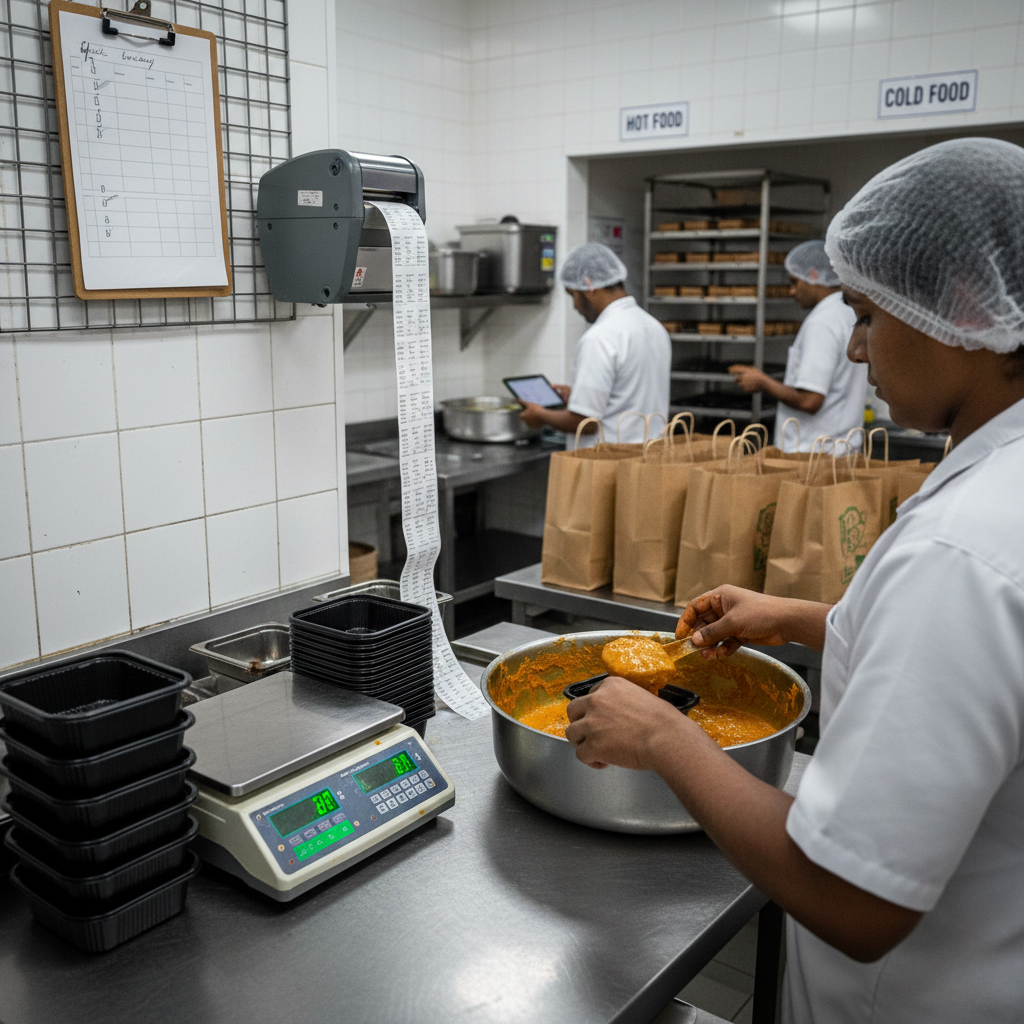
- Pre-portion critical items (proteins, gravies, sauces) using fixed tools
- Label everything (date, time, product, owner). No label, no use.
- Keep “peak kits” ready: dips, cutlery, tissues, seals, stickers
Station 2: Assembly
- SKU cards visible near station: what goes in, in what quantity
- Default plating for delivery: reduce leak risk and sogginess
- Separate hot and cold assembly zones if you run both
Station 3: Packing
- Packing checklist printed and followed per order
- Seal rule: avoid spill, maintain trust, reduce refunds
- Bag building logic: heavy at base, cold separate, label outside
Station 4: Dispatch shelf
- Dedicated dispatch shelf with clear marking
- Handover protocol: order confirmation + bag check
- Escalation rule for delayed rider pickup
Inventory + Portion Control Without Leakage
Operations consulting often pays back fastest through inventory discipline. Food cost increases quietly because of small daily leaks: extra gravy, untracked wastage, broken FIFO, and “we ran out so we bought locally” purchases. The fix is not strictness it’s clarity and tracking.
Hub-level controls (even for single kitchens)
- Par levels for top items + reorder triggers
- FIFO storage rules (front labels, shelf discipline)
- Packaging count like inventory (hidden leak)
- Theoretical vs actual variance review weekly
Portion control that staff actually follows
- Fixed ladles/scoops and portion cups per station
- SKU-wise BOM sheet (grams + ml, not “as required”)
- Random portion audits during peak (spot checks)
- Wastage log with reason codes (expiry, burn, spill, error)
If you’re budgeting and planning expansion: Cloud Kitchen Setup Cost in India.
Quality, Complaints & Rating Stability
Cloud kitchen quality is not only taste. It’s the combined experience: temperature, texture, packaging integrity, and order accuracy. A consultant reduces complaint categories by building preventive systems. When complaints reduce, ratings stabilize; when ratings stabilize, the algorithm becomes your friend.
Top complaint sources and operational fixes
- Cold food: dispatch shelf rules + faster pack cycle + timed finishing
- Leakage: container upgrades + sealing + bag building rules
- Missing items: packing checklist + “2-step verification” for add-ons
- Taste drift: tool mapping + batch SOPs + reference tasting points
- Soggy texture: vented packaging + separate sauce + finishing timing
Daily KPIs + Weekly Review Loop
A cloud kitchen becomes stable only when decisions are made from visible numbers. The goal is not to track everything just the metrics that reveal drift early. A consultant sets up simple daily tracking and a weekly review rhythm.
Speed KPIs
- Prep-to-pack time (avg + peak)
- On-time dispatch %
- Peak backlog minutes
Accuracy KPIs
- Packing error rate
- Missing add-on complaints
- Refund/issue rate
Cost KPIs
- Food cost % drift
- Wastage %
- Packaging cost/order
Quality KPIs
- Avg rating trend
- Complaint category mix
- Repeat order signals
If you run multiple brands from one kitchen: Multi-Brand Cloud Kitchen Model.
30-Day Operations Stabilisation Playbook
Days 1-7: Diagnose + design
- Map the full order journey and identify bottlenecks
- Collect complaint patterns + station observations
- Create “Top 10 issues” list with owners and deadlines
Days 8-15: SOP rollout + station fixes
- Implement opening/closing SOPs + packing SOP
- Tool mapping for portion control (ladles/scoops/timers)
- Design packing table checklist and label discipline
Days 16-23: Inventory + peak readiness
- Set par levels and reorder triggers for critical items
- Build peak kits and peak prep schedule
- Reduce menu friction (remove redundant variants)
Days 24-30: KPIs + weekly loop
- Start daily KPI tracking and review
- Run one weekly ops review meeting
- Lock one improvement per week as a permanent habit
Scaling reference: How to Scale to Multiple Locations.
Common Mistakes in Cloud Kitchen Operations
1) SOPs exist, but tools don’t
If you don’t give fixed tools (ladles, timers, portion cups), staff will estimate. Estimation becomes drift.
2) Packing is treated as “last step”
Packing is the final product experience. Most refunds are packing, not cooking. Build it like a station.
3) No peak prep plan
Peak feels chaotic when prep is not scheduled. A prep plan converts peak into a predictable routine.
4) Inventory is “managed by feel”
Without par levels and variance review, food cost will drift silently and then explode.
5) Founders try to fix everything at once
Ops improves faster with one change per week. Small wins compound into a stable kitchen.
FAQ: Cloud Kitchen Operation Consultant
Do I need an operations consultant if I have a kitchen manager?
Many managers run daily tasks, but they may not build systems. A consultant designs the framework and upgrades execution discipline.
How fast can operations improvements show results?
Packing and dispatch fixes often show improvement within 7-14 days. Food cost and inventory discipline usually stabilise over 3-6 weeks.
What is the biggest ROI area in cloud kitchen operations?
Typically: packing accuracy, leakage reduction, and portion control. These reduce refunds, complaints, and food cost drift.
Will operations consulting help me scale multiple locations?
Yes. Scaling fails when execution is not standardised. Operations creates repeatability so new outlets don’t become chaos.
Can GrowKitchen implement systems, not just suggest them?
Yes. We help implement SOPs, station workflows, checklists, KPI tracking, and weekly review loops so your kitchen runs like a system.
Want a Cloud Kitchen Operations System Built for Your Brand?
Share your city, current order volume, number of staff, and menu type. We’ll diagnose bottlenecks, implement SOPs, fix packing/dispatch, stabilise inventory, and set KPIs that keep performance predictable.
Book a Free Discovery CallGet a Custom Cloud Kitchen Plan for Your Brand
Not sure how to start or scale your cloud kitchen in India? Share a few details about your brand and we’ll send you a personalised setup and growth roadmap.
- City-wise kitchen and location suggestions
- Approximate investment & profit estimates
- Menu and positioning recommendations
- Whether CKaaS or own kitchen suits you better
Fill the form and our team will get in touch within one working day.
About Us
Ckaas Sloutions
Contact
Follow On
© 2025 Grow Kitchen. All rights reserved.
WhatsApp us